



“Let’s go, let’s get them”
During Prostate Cancer Awareness Month, Telix is speaking with the advocates and patients on the front line of fighting prostate cancer.
Michael Ramos served for 16 years as the elected District Attorney of San Bernardino County, California. In 2017, a year before he planned to retire, he was diagnosed with prostate cancer. We spoke with him about his diagnosis, the scan that changed the course of his care, and why he now brings a prosecutor’s energy to patient advocacy.
The diagnosis
A shock diagnosis
Michael Ramos spent his entire career as a public servant. He started as a probation officer, went to law school, and became a trial lawyer in the district attorney’s office, where he tried 125 jury trials driven by a passion for crime victims. In 2002, he was elected District Attorney of San Bernardino County, California, a position he held for 16 years, working with governors and legislators along the way.
He was also, by any measure, healthy.
“I used to do triathlons,” he says. “I worked out every day. I had a very stressful job. People would go to lunch, I’d go to the gym.”
Then in 2017, a year before he was going to retire, Michael was diagnosed with prostate cancer.
“It took me back. I remember going to my car and just sitting in my driver’s seat. The first person I called was my wife, and I said, here’s the news. And along with that, it was, okay, what now?”
Michael’s shock is shared by many of the men who receive the same news each year. Around one in eight men will be diagnosed with prostate cancer in their lifetime, and in 2026 an estimated 333,830 new cases will be diagnosed in the United States alone.1 It remains the second-leading cause of cancer death in American men, behind only lung cancer.1
Prostate cancer in the United States, 2026 estimates.
The decisionWhat now? Building a support team
Michael’s answer to that question came from two directions: his medical team and his family. Together with his urologist, his wife, his son and his daughter, he sat down and worked through the options, from surgery to remove the prostate to radiation and brachytherapy.
“The combination of both sitting down professionally with a medical doctor and then with the people that really care and love you, that’s how we made the decision,” he says. “It made it easier having that kind of a team.”

Michael began treatment, including around two years of hormone therapy. Then his PSA started climbing again.
PSA stands for prostate-specific antigen, a protein made by cells in the prostate gland. Small amounts of PSA can enter the bloodstream, where it can be measured with a simple blood test. Higher levels can be an early sign of a prostate problem, including cancer.
For men treated for prostate cancer, a rising PSA is a familiar and feared turn. Between 27% and 53% of patients who undergo surgery or radiation therapy will go on to experience biochemical recurrence.2 The critical question then becomes where the cancer is, and conventional imaging such as CT and bone scans can struggle to locate small sites of disease.3
The scanFinding every cell
Years earlier, Michael had read a newspaper article about a doctor at Loma Linda University Medical Center who was, in his words, doing fantastic stuff with nuclear medicine. He kept the article. When his PSA began rising, he tracked down its subject, Dr. Frankis Almaguel, Director of Molecular Imaging and Therapeutics at Loma Linda University Cancer Center. They met at his lab two days later.
“He told me, we want to do a PSMA-PET scan so we can actually see where the cancer cells are,” Michael says.
Prostate-specific membrane antigen (PSMA) is a protein found at high levels on the surface of most prostate cancer cells, making it a powerful target for molecular imaging.4 By pairing a radioactive tracer with a molecule that binds to PSMA, positron emission tomography (PET) can show physicians where prostate cancer cells are in the body. In a landmark clinical trial, PSMA-PET imaging was significantly more accurate than conventional imaging (CT and bone scanning) in men with high-risk prostate cancer.3
Michael’s scan revealed two areas of disease. Rather than leaving him to wait for a report, his doctor stayed to walk him through the images on screen.
“The beautiful thing is he stayed to explain to me the results,” Michael says. “There were two places where it kind of lit up. I remember feeling like, okay, let’s go, let’s get them.”
For a career trial lawyer, the appeal of seeing the disease was empowering.
“The result was like a game plan. It was a great piece of, I’ll use my analogy again, evidence. Direct evidence, not circumstantial. Here it is. Here’s the plan.”
Armed with the scan, Michael’s care team, spanning nuclear medicine, radiation oncology, medical oncology and urology, mapped out targeted treatment for the sites of disease. After his first treatment two years ago, his PSA fell sharply.
Asked whether he would have reached the same plan, and the same confidence, without the scan, his answer is blunt.
“No. I’m not sure where I’d be. I’m sure they would have tried other treatments, but this was a game changer, because we could come up with a specific plan.”
At Telix, PSMA-PET imaging sits at the core of our prostate cancer portfolio, developed to help physicians see the location and extent of disease and support more informed treatment decisions at critical points in the patient journey. We are also advancing investigational PSMA-targeted radiopharmaceutical therapies, designed to deliver cancer-killing radiation directly to diseased cells while limiting the impact on surrounding healthy tissue. This theranostic approach, pairing precision diagnostics with targeted therapy directed at the same molecular target, is central to our work in prostate cancer and beyond.
AdvocacyPutting cancer in prison
Michael retired from the district attorney’s office, but not from public service. Having met many people living with cancer, he has found a new focus for the energy he once brought to the courtroom.
“My passion has changed,” he says. “I still care about crime victims, of course, but now, as a cancer survivor, it is my priority to do what I can as an advocate to help those people that have had this diagnosis of cancer.”

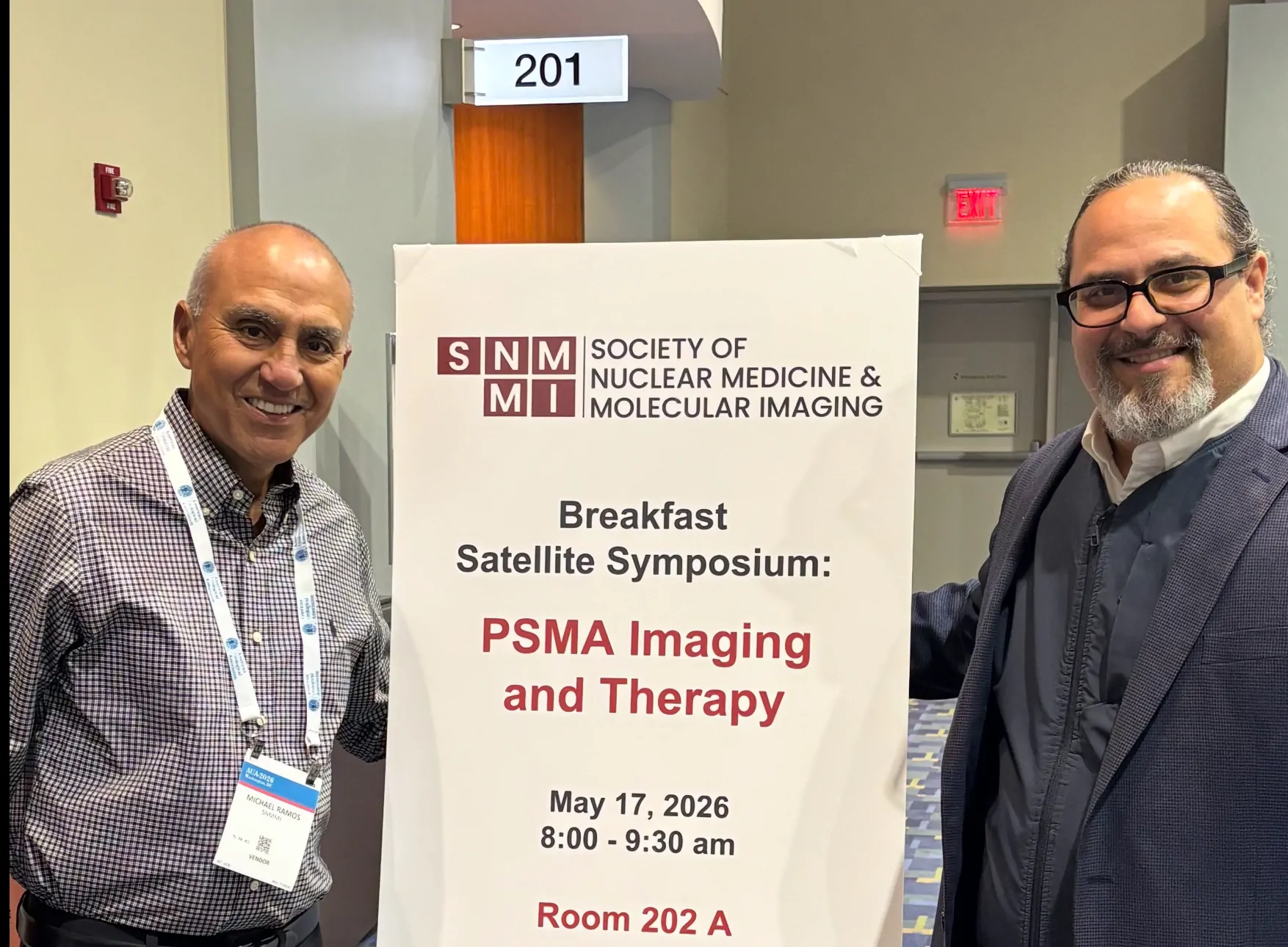
He follows the field closely, listening to doctors at conferences and watching the pace of progress. Even now, he talks about the disease the way a prosecutor talks about a case.
“Like I used to put criminals in prison for hurting victims, we’re going to put cancer in prison,” he says. “The technology is amazing. With companies like this and doctors like Dr. Almaguel, we will be able to not just keep us alive for another year or two.”
When asked what he would say to other men facing a prostate cancer diagnosis today, his answer is immediate.
“Don’t lose hope. Technology has changed so much since I was diagnosed. As I listen to doctors at various conferences, the future is bright. You’re going to live a long life. You will live a long life.” Michael Ramos

References
- American Cancer Society. Key Statistics for Prostate Cancer. cancer.org. Cancer Facts & Figures 2026.
- Artibani W, et al. Management of Biochemical Recurrence after Primary Curative Treatment for Prostate Cancer: A Review. Urol Int. 2018;100(3):251–262.
- Hofman MS, et al. Prostate-specific membrane antigen PET-CT in patients with high-risk prostate cancer before curative-intent surgery or radiotherapy (proPSMA): a prospective, randomised, multicentre study. Lancet. 2020;395(10231):1208–1216.
- Silver DA, et al. Prostate-specific membrane antigen expression in normal and malignant human tissues. Clin Cancer Res. 1997;3(1):81–85.
This article is for educational and disease-awareness purposes and does not constitute medical advice or product promotion.